Share this intervention

Summary

Generating Opportunities to Attain Lifelong Success (GOALS) provided intensive case management followed by occupational skills training, job placement services with dedicated employment liaisons and postemployment services, targeting SNAP participants who were work registrants.

Generating Opportunities to Attain Lifelong Success (GOALS) provided intensive case management followed by occupational skills training, job placement services with dedicated employment liaisons and postemployment services, targeting SNAP participants who were work registrants.GOALS began with a stabilization phase of intensive case management that included barrier identification and developing an individualized action plan to address mental health, substance use, basic education, and/or life skills needs, as indicated. This phase was followed by train, place, and sustain phases, where participants could be referred to occupational skills training, if indicated, and receive job placement assistance and post-employment supports from employer liaisons.

The stabilize phase took about 8 weeks to complete, with the basic education or life skills trainings typically taking 5 to 8 weeks and requiring full-day attendance for 4 days per week. In the train phase, the occupational skills training programs lasted four to six weeks. Case management after the stabilize phase included at least monthly meetings and continued up through job placement.

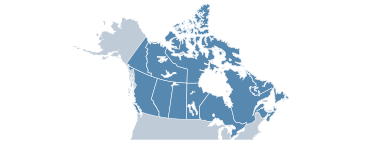
The study was conducted in 35 counties statewide in Kansas.

Populations and employment barriers: Public benefits recipients, Adults (age 25+), Unemployed

Effectiveness rating and effect by outcome domain

Need more context or definitions for the Outcome Domain table below?
View the "Table help" to get more insight into terms, measures, and definitions.

View table help

Scroll to the right to view the rest of the table columns

Outcome domain Term Effectiveness rating Effect in 2024 dollars and percentages Effect in standard deviations Sample size
Increase earnings Short-term Little evidence to assess support favorable $510 per year 0.014 3961
Long-term Little evidence to assess support favorable $292 per year 0.008 3961
Very long-term No evidence to assess support
Increase employment Short-term Supported favorable 3% (in percentage points) 0.078 3961
Long-term Little evidence to assess support favorable 0% (in percentage points) 0.002 3961
Very long-term No evidence to assess support
Decrease benefit receipt Short-term Not supported unfavorable $134 per year 0.039 3961
Long-term Little evidence to assess support unfavorable $55 per year 0.016 3961
Very long-term No evidence to assess support
Increase education and training All measurement periods No evidence to assess support

Studies of this intervention

Study quality rating Study counts per rating
High High 1

Implementation details

Dates covered by study

GOALS enrolled participants between January 2016 and January 2018 with a follow-up period of at least three years after enrollment.

Organizations implementing intervention

The Kansas Department of Children and Families (DCF) managed the overall program and provided case management. DCF partnered with the University of Kanasis’s Center for Public Partnerships in Research to build staff capacity and skills, convene community stakeholders, and manage program data. DCF also partnered with an array of community colleges and technical education centers for job readiness and occupational skills trainings.

Populations served

GOALS was targeted to new and current SNAP work registrants. The average participant was white (51 percent), female (61 percent), and had a high school diploma or equivalent (77 percent). Most participants were unemployed (84 percent).

Description of services implemented

GOALS had four phases of services:

  • Stabilize phase. GOALS career navigators provided intensive case management, beginning with multiple assessment meetings and developing an individualized action plan. The plan could include mental health or substance use counselling and/or basic education and life skills training and work experience.
  • Train phase. If indicated by the career navigator, participants were referred for four to six weeks of occupational skills training at programs offered by local community colleges or technical education centers. Career navigators continued to provide case management during this phase.
  • Place phase. After participants’ resumes were completed and navigators deemed them work ready, employer liaisons identified potential job placements that matched skills and interests, including with employers the liaisons had recruited into the program. This phase could also include individual advocacy, such as hand-delivery of job application materials. Navigators continued to provide case management up through job placement.
  • Sustain phase. Employer liaisons addressed any job retention challenges, such as transportation needs, and could also help with rapid reemployment if job loss occurred.

Service intensity

GOALS’ stabilize phase took about 8 weeks to complete, with the basic education or life skills trainings typically taking 5 to 8 weeks and requiring full-day attendance for 4 days per week. It also could include up to two weeks of work experience. In the train phase, the occupational skills training programs lasted four to six weeks. Case management after the stabilize phase included at least monthly meetings and continued up through job placement.

Comparison conditions

The control group was eligible for existing SNAP E&T services and any employment and training services available in the community. Kansas offered limited services through its existing voluntary SNAP E&T program (except in the Southeast region where SNAP E&T was not available), including limited occupational skills training, primarily in Certified Nursing Assistantships, potential referrals to GED services and local workforce development centers for training, and limited support services.

Partnerships

The Kansas Department of Children and Families (DCF) managed the overall program and provided case management. It also partnered with:

  • University of Kanasis’s Center for Public Partnerships in Research (KU). KU built DCF staff capacity and skills, convened community stakeholders, and managed program data.
  • Local community colleges and technical education centers. Provided job readiness and occupational skills training programs.

Staffing

GOALS included two key DCF staff roles:

  • Career liaisons. Liaisons recruited local employers to participate in GOALS, including leading Q&A sessions with participants and workplace tours in the stabilize phase. They developed placements with employers and matched participants to available jobs, which could include individual advocacy and hand-delivery of resumes or job applications. They also provided post-employment supports for job retention, such as transportation assistance, and assistance with rapid reemployment if job loss occurred.
  • Career navigators. Navigators provided intensive case management during stabilize phase, included multiple assessment appointments, development of individualized action plan, and making referrals. They provided ongoing case management and met at least monthly with participants up through job placement, including providing support services such as financial assistance for transportation, interview clothing costs, or license or testing fees.

Staff at local community colleges or technical education centers delivered the adult basic education, life skills, occupational skills, and/or job readiness training.

Fidelity measures

The study did not discuss any tools to measure fidelity to the program model.

Funding source

The program was funded by federal SNAP E&T Pilot demonstration funding from the U.S. Department of Agriculture.

Local context

GOALS was implemented in 35 counties statewide in Kansas. Kansas DCF has multiple offices statewide with a central office in Topeka, KS. The University of Kansas’s Center for Public Partnerships and Research is located in Lawrence, KS.

Characteristics of research participants
Black or African American
24%
White, not Hispanic
51%
Asian
1%
Another race
2%
More than one race
7%
Hispanic or Latino of any race
16%

The Pathways Clearinghouse refers to interventions by the names used in study reports or manuscripts. Some intervention names may use language that is not consistent with our style guide, preferences, or the terminology we use to describe populations.